Sunday, 13 May 2012

Staging the World: Review


The British Museum is soon to stage a major exhibition on the world of Shakespeare in collaboration with the Royal Shakespeare Company. The exhibition provides an insight 'into the emerging role of London as a world city, seen through the innovative perspective of Shakespeare’s plays.' It is part of the World Shakespeare Festival and runs from 19 July – 25 November 2012.

The British Museum Press has released several publications to compliment the exhibition, and kindly sent me review copies. A further book on Shakespeare and Food is forthcoming shortly. The titles I'm reviewing here are Shakespeare: Staging The World, Shakespeare's Britain, and Angels and Ducats: Shakespeare's Money and Medals,

First up is the rather splendid ShakespeareStaging The World by Jonathan Bate and Dora Thornton. This is a big beautiful book, which considers the early modern period through the eyes of Shakespeare; its premise being that the things he, his players, and his audience saw, 'mattered at least as much as what they read in shaping their vision of the world.' This is cleverly illustrated by the juxtaposition of a stunning collection of early modern objects with Shakespeare's characters and plays.
To look at a woodcut of a Jewish household in Venice and a sixteenth-century Caribbean wood carving of a spirit imprisoned in a tree and a pack of playing cards in which Cleopatra and Queen Elizabeth appear side-by-side is to be given a new historical and intellectual perspective on the characters of Shylock, Ariel and Cleopatra.     
The book not only serves as a catalogue of the objects on display at the exhibition, it features a rich and detailed commentary by the Shakespearean scholar Jonathan Bate, and the exhibition's curator, Dora Thornton, which in and of itself enriches both existing scholarship, and our knowledge of daily life in early modern England. The book is divided into nine chapters, each of which explores a specific theme and the objects which serve to bring it to life. For example, Chapter One gives an overview of London in 1612; a World City. It provides a narrative of aspects of London life at this time, and considers the theatres as bustling commercial enterprises. One of the most compelling objects featured in this chapter is a surviving turned oak baluster excavated from the site of the Rose theatre. It may have been part of the safety rail around the upper galleries:

© The Trustees of The British Museum


Subsequent chapters explore Country, County and Custom, Kingship and the English Nation, The Legacy of Rome, Venice Viewed from London, The Noble Moor, The Scottish Play, and the Matter of Britain. Each is illustrated throughout with truly mouth-watering photographs, illustrations, maps, and woodcuts. One of my favourite objects is this Horn-book from the late 1600s, comprising a sheet of printed paper protected by a layer of horn, similar to the one from which Shakespeare himself would have learned his alphabet and Lord's Prayer while at school:


© The Trustees of The British Museum


One of the many facts I discovered while reading Staging The World, is that in 1571, a statute was enacted enforcing the wearing of woolly caps by everyone over the age of six on Sundays and holidays. This knitted man's cap was found in Moorfields, London and dates to the mid-sixteenth century:


 © The Trustees of The British Museum


Perhaps my favourite object is this lantern, traditionally associated with Guy Fawkes. It was given to the University of Oxford in 1641 as a memento of the Gunpowder Plot. It's made from sheet iron and would originally have had a horn window so it could be completely closed to hide the lighted candle within:  


 © The Trustees of The British Museum


Shakespeare: Staging The World is more than just a museum catalogue, it's a stunning collection of early modern objects brought vividly to life by Jonathan Bates and Dora Thornton. I'd endorse it for anyone with an interest in Shakespeare or early modern England. For the Shakespeare scholar it's a valuable addition to the bookshelf, for the historian it's a smorgasbord of early modern artifacts. For the general reader it's a beautifully illustrated and informative guide to the world of Shakespeare. Highly recommended. Shakespeare: Staging The World, Jonathan Bate and Dora Thornton (The British Museum Press: London, 2012) (£25).


A smaller, shorter version of Staging The World can be found in Shakespeare's Britain, also by Jonathan Bate and Dora Thornton. It contains a condensed overview of some of the objects found in Staging The World and has a specific focus on Shakespeare and Britain; a theme which preoccupied the playwright in his later years, and one which was ushered in by James I who longed for a unified kingdom. Perfect for someone who wants to get a flavour of the period, it neatly encapsulates Shakespeare's Britain with lavish illustrations. I particularly love the cover image, which comes from a watercolour entitled 'Going to Bankside' painted by Michael Van Meer in 1619, and depicts some rather fancy-looking people enjoying a trip across the Thames to Bankside, perhaps to see one of Shakespeare's plays. Shakespeare's Britain, Jonathan Bate and Dora Thornton (The British Museum Press: London, 2012) (£9.99)  


The final book, Angels and Ducats: Shakespeare's Money and Medals, is a fascinating catalogue of the coins on display at the exhibition. As anyone who's been forced to admire my Elizabethan sixpence will testify, I do love sixteenth and seventeenth century coins. Not because I have any interest in numismatics, but because they give us pause to wonder just who's pocket they've been in, and as such, they connect us with history in a real and immediate way.

© The Trustees of The British Museum

The above ducat dates from the office of Marino Grimani, Doge of Venice from 1595-1605. Ducats were, in origin, 'the defining gold coin of Venice, but the term also meant any coin of the same standard and it was widely used and familiar.'

Another coin, perhaps my favourite, is a milled sixpence dated 1562, depicting the profile of Elizabeth I. It's in much better condition than my own. Milled sixpences were machine-made coins circulated in the early 1560s at the beginning of Elizabeth's reign. They were treasured at the time, and often used as reckoning-counters.


    © The Trustees of The British Museum

As well as using sixpences as counters, specially-made counters were available for accountants, and a bag or cylinder of counters served as an early modern calculator. The Clown, in The Winter's Tale, talks of his need for counters before he goes shopping: 
I cannot do't without counters. Let me see, what am I to buy for our sheep-shearing feast? Three pounds of sugar, five pounds of currants, rice - what will this sister of mine do with rice?
(4.3.32-4)
Below is a set of silver counters depicting the Stuart royal family, dating to the 1600s. The accompanying silver box holds all twenty-nine counters.


 © The Trustees of The British Museum

Angels and Ducats fulfils a valuable role. It enables us to see for the first time exactly what the coins Shakespeare refers to in his plays actually look like. In this way this book enriches our understanding of both Shakespeare's work and his life. Angels and Ducats is essential reading for anyone interested in the themes of money and finance on the London stage, but beyond that it is a wonderful introduction to the variety of coins in circulation in early modern England. Angels and Ducats: Shakespeare's Money and Medals (The British Museum Press: London, 2012) (£9.99).

All three offerings from The British Museum Press are beautifully written and stunningly illustrated. If I had to recommend one, it would be Shakespeare: Staging The World, since it covers all the objects included in the exhibition. However Shakespeare's Britain is a neat precis of some of the objects on display and Angels and Ducats is unique in its study of specific coins in England during this period. If you're intending to visit the exhibition then any or all of the books are a great way to familiarise yourself with the history of the objects on display. If you can't make the exhibition then each of the books serves as charming compensation. But in their own right, all three deserve a place on any bookshelf.

The books can be bought via The British Museum Bookshop online. Tickets for the exhibition Shakespeare: Staging The World can be bought here.    

Monday, 23 April 2012

Monday, 19 March 2012

The more affliction we endure

Queen's House, Tower of London

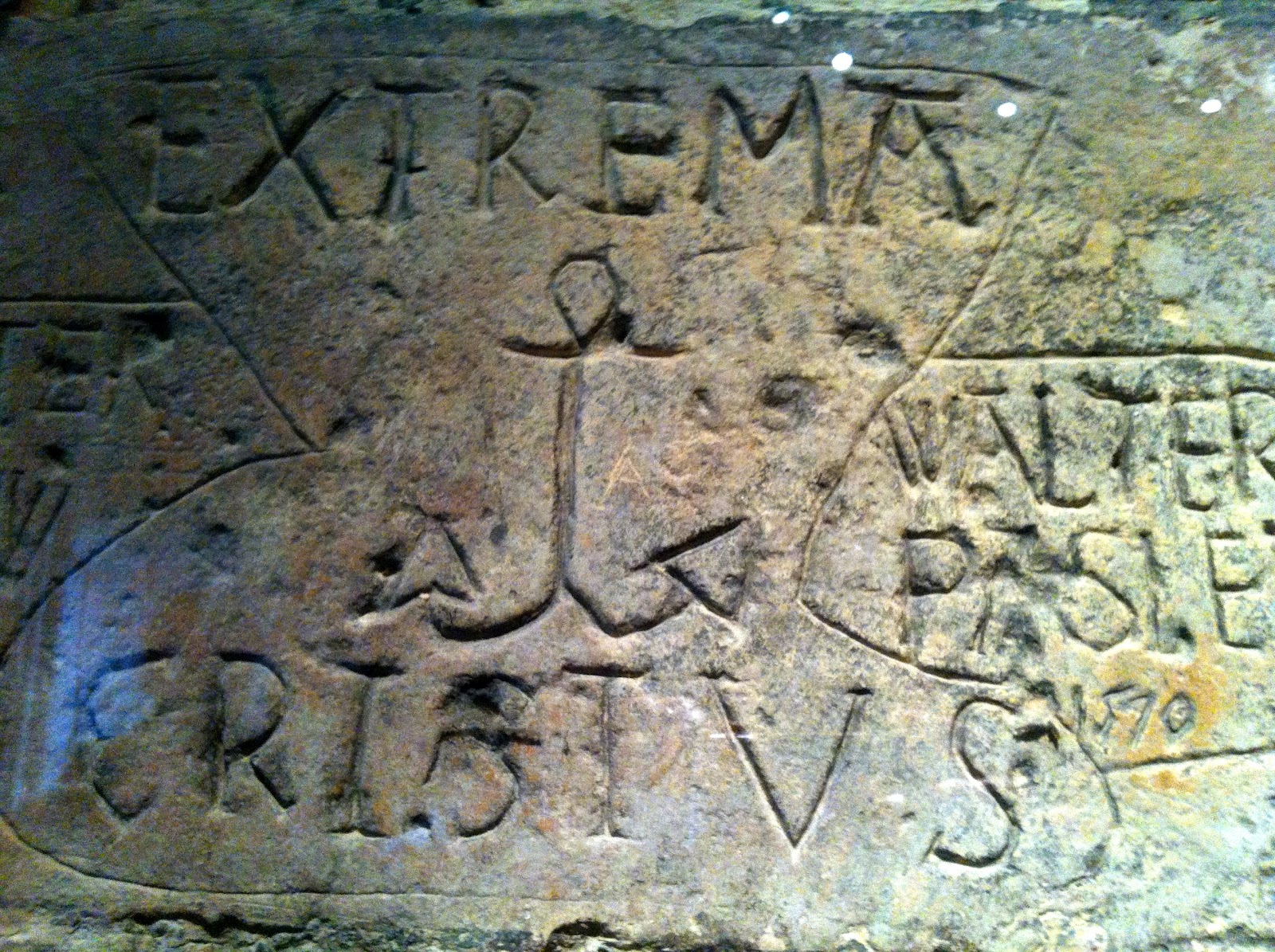
I thought it might be interesting to share some photographs of Tudor graffiti in the Tower of London. I should point out that I am in no way a photographer, and the photos below were taken inside the Beauchamp Tower with an iPhone. As such the quality is quite poor. However the photos do convey a sense of the incredible graffiti carved into the walls; there is something very moving about these personal imprints, carved during a time of fear and, often, abject despair.

Beauchamp Tower stands adjacent to the above building in the Tower complex. Its proximity to what had been the Lieutenant's Lodgings made it an ideal place to hold high-profile prisoners in the sixteenth and seventeenth centuries. Some of its more famous occupants include Robert Dudley, Earl of Leicester, imprisoned for a year in the Tower in 1553, and Sir Philip Howard, Earl of Arundel, who died at the Tower after ten years of incarceration. The upper and lower floors of Beauchamp Tower are littered with personalised graffiti, now carefully preserved behind perspex screens.  

Beauchamp Tower


Robert Dudley's initials?


Earl of Arundel


Thursday, 15 March 2012

Some vaine fantasticall illusion by Mackbeth and Banquho


Title page Holinshed's Chronicles (1577)

It has long been noted that the Elizabethan historian Ralph Holinshed's Chronicles served as a source for Shakespeare, particularly in relation to his history plays, as well as King Lear, Macbeth, and Cymbeline. Until the twentieth century, Chronicles was largely consigned to marginalised scholarly study, however today it is regarded as a 'secular equivalent to John Foxe's Acts and Monuments, a massive and wide-ranging work of scholarship'. This post explores a little of the history of its production.

Raphael Holinshed (c.1525-1580?) was the son of Ralph Holinshed, or Hollingshead, of Sutton Downes, Cheshire. Some accounts of his life suggest he was educated at Cambridge, but more credible reports indicate he was a 'minister of God's word' and a proponent of the emerging Protestant Church. During the reign of Mary Tudor, when he was in his late twenties and early thirties, he was employed in London at the printing house of the evangelical Reyer Wolfe. Wolfe had employed Holinshed to help him with his 'universal cosmography' - an enormous description of the history and geography of the world complete with maps.

Macbeth battle scene from the 1577 edition of Chronicles 


The first edition of Chronicles of England, Scotland, and Ireland was printed in 1577. 'It formed part of a deliberate movement to elevate the status of England, English letters, and English language through writing and publishing maps, histories, national epics, and theoretical works on English poetry'. In 1547, Wolfe had been issued with a royal privilege to act as the king's printer in Latin, Greek, and Hebrew. This included the exclusive right to print charts and maps which might be useful to king and country.

Wolfe died in 1573, when Chronicles was still incomplete. His wife Joan died the following year, stipulating in her will that Holinshed had permission to complete, and benefit from, the work. Unfortunately for Holinshed, Wolfe's printing business had been inherited by his son Robert, and his son-in-law, John Hun. They joined with two other men to create a printing consortium with the intention of printing Chronicles. To publish the volumes, they turned to Henry Bynneman, who had royal privilege to print 'all Dictionaries in all tongues, all Chronicles and histories whatsoever’.

In 1577 the huge two-volume Chronicles was finally published, with Holinshed on the title page. However, Holinshed appears to have been disappointed with the work. He considered it too limited in scope in comparison with the original 'universal cosmology' envisioned by Wolfe. He blamed the consortium headed by Wolfe's son, as did other contributors, including William Harrison, the author of the ‘Historicall description of the island of Britain’, which prefaced the work. Harrison suggested that the speed with which he had been forced to write his contribution may have led to both errors and omissions.

Chronicles was a great publishing success. It was an expensive book; a copy selling in 1577 for £1.6s (c.£200) would have made it one of the most costly books in a university student's possessions. But its success also suggests how 'informed Elizabethans were coming to place the understanding of their own history alongside the classics as part of the education of a young gentleman preparing for government service.'

It is unclear how much Holinshead himself benefited from sales of the book. In 1578 he was living in Warwickshire, serving as steward to Thomas Burdet, and by 1580 he had died, leaving his books and papers to Burdet.

All hail Makbeth, from the 1577 edition

Chronicles went into a second reprint in 1585-7. This time it was printed by Henry Denham, at the expense of John Harrison, George Bishop, Ralph Newbury, and Thomas Woodcocke. They treated its reprint with tremendous care. While Reyer Wolfe had worked with Holinshed on the 1577 edition, the 1587 edition was placed under the supervision of Abraham Fleming. Fleming acted as general editor, and revised the book, extending the English history to 1586. The 1587 edition of Chronicles was printed in three volumes. The first comprising Harrison's 'Historical description' and the 'History of England' up to 1066. The second is a description and history of Ireland, revised and extended by John Hooker, as well as the history and description of Scotland by Francis Thynne. The third comprises the History of England by Holinshed, revised by Fleming, with contributions from John Stow.

Title page to the second edition (dated 1586)

Both editions of Chronicles were extensively censored by the Elizabethan authorities. In 1587, for example, passages pertaining to Scottish history were removed for fear they might damage Anglo-Scottish relations, and Chronicles' final revision, 'very likely dictated by political developments that followed the completion of the first and second reformations, reflects a careful attempt to cultivate good opinions both at home and abroad, and especially abroad, ahead both of English efforts to negotiate a settlement in the Low Countries and of the expected response to the execution of Mary, queen of Scots. '

Some extant copies escaped censorship, while others reveal varying degrees of alteration. In 1590, James VI demanded a further censoring of the text, but eventually relented, permitting the offending passages to remain. In the eighteenth century, new copies of pages previously censored from Chronicles, were published, with the intention they should be inserted into those existing copies with omissions. As a result, many of the 1587 copies include eighteenth century alterations. A third edition was published in 1807-8, which restored the censored pages and passages, but reordered the descriptions and histories.

As far as Shakespeare is concerned, my own guess is that he would have been familiar with both editions of Chronicles. The 1577 copy may have appeared in his school, perhaps in his final year. In all likelihood he owned a 1587 edition, purchased during his years in London. He may have initially borrowed a copy while composing his history plays in the early 1590s, but the cost of buying Chronicles would not have been such a stretch in the years immediately preceding the composition of King Lear in 1604-5.

Three weird sisters and Makbeth, also from the 1577 edition

All quotes are from Cyndia Susan Clegg, ‘Holinshed , Raphael (c.1525–1580?)’, Oxford Dictionary of National Biography, Oxford University Press, 2004; online edn, Jan 2008

Holinshed?

Friday, 9 March 2012

St Paul's Cross

The outdoor pulpit known as St Paul's Cross, painted by John Gipkyn (fl 1594–1629) in 1616. 

Today I discovered this lovely painting of St Paul's Cross, a site of much historical importance.

Public sermons and announcements were delivered to Londoners from St Paul's Cross, the first in 1236, when a member of the king's counsel announced Henry III's wish to govern London well and punish those who interfered with its citizens. In 1422, Richard Walker, a chaplain of Worcester, appeared at the Cross to to plead guilty to charges of sorcery. Sermons which helped establish the English Reformation were delivered from here, and several riots began on this spot. Londoners were told of the discovery of the Gunpowder Plot in a sermon delivered at St Paul's Cross on November 10th by William Barlow. In 1643 the Cross was destroyed by the Puritans during the first English Civil War, and it was rebuilt, minus the pulpit, in 1910.

St Paul's Cross today

Thursday, 8 March 2012

The severall habits of English women


Today I stumbled upon these gorgeous etchings of women by Wenceslaus Hollar. The lovely detail provides a fascinating insight into women's fashion in the mid-seventeenth century, even down to the shoes. All images are taken from The severall habits of English women, from the nobilitie: to the contry woman, as they are in these times, Wenceslaus Hollar (1640).


I am by your council from you commanded to go to the Tower

Elizabeth I Coronation Portrait. 
Copy c.1600-1610 by an unknown painter of a lost original of 1559. 
Currently on display in the National Portrait Gallery, London.


To celebrate International Women's Day, the desperate letter written by Elizabeth in one of her darkest hours to her sister, Queen Mary, in response to the order that Elizabeth be committed to the Tower of London. As everyone knows, the twenty-one-year-old Elizabeth survived the Tower, and subsequently went on to rule England for forty-five years.

March I6, I554 
If any ever did try this old saying, 'that a king's word was more than another man's oath,' I most humbly beseech your Majesty to verify it to me, and to remember your last promise and my last demand, that I be not not condemned without answer and due proof, which it seems that I now am; for without cause proved, I am by your council from you commanded to go to the Tower, a place more wanted for a false traitor than a true subject, which though I know I desire it not, yet in the face of all this realm it appears proved. I pray to God I may die the shamefullest death that any ever died, if I may mean any such thing; and to this present hour I protest before God (Who shall judge my truth, whatsoever malice shall devise), that I never practised, counselled, nor consented to anything that might be prejudicial to your person anyway, or dangerous to the state by any means. And therefore I humbly beseech your Majesty to let me answer afore yourself, and not suffer me to trust to your Councillors, yea, and that afore I go to the Tower, if it be possible; if not, before I be further condemned. Howbeit, I trust assuredly your Highness will give me leave to do it afore I go, that thus shamefully I may not be cried out on, as I now shall be; yea, and that without cause. Let conscience move your Highness to pardon this my boldness, which innocency procures me to do, together with hope of your natural kindness, which I trust will not see me cast away without desert, which what it is I would desire no more of God but that you truly knew, but which thing I think and believe you shall never by report know, unless by yourself you hear. I have heard of many in my time cast away for want of coming to the presence of their Prince; and in late days I heard my Lord of Somerset say that if his brother had been suffered to speak with him he had never suffered; but persuasions were made to him so great that he was brought in belief that he could not live safely if the Admiral lived, and that made him give consent to his death. Though these persons are not to be compared to your Majesty, yet I pray to God the like evil persuasions persuade not one sister against the other, and all for that they have heard false report, and the truth not known. Therefore, once again, kneeling with humbleness of heart, because I am not suffered to bow the knees of my body, I humbly crave to speak with your Highness, which I would not be so bold as to desire if I knew not myself most clear, as I know myself most true. And as for the traitor Wyatt, he might peradventure write me a letter, but on my faith I never received any from him. And as for the copy of the letter sent to the French King, I pray God confound me eternally if ever I sent him word, message, token, or letter, by any means, and to this truth I will stand in till my death.Your Highness's most faithful subject, that hath been from the beginning, and will be to my end, 
ELIZABETH, 
I humbly crave but only one word of answer from yourself.

 The original letter (held in PRO State Papers Domestic Mary I ii/4/2, fol. 3)


Further reading: Elizabeth I: Collected Works, eds. Leah Marcus, Janel Mueller, Mary Beth Rose (University of Chicago Press, 2002)