Friday, 13 January 2012

Vill you not stay in my bosom tonight, love?


This week I've been reading several of the rather numerous Shakespeare biographies cluttering up my bookshelves, and I was intrigued to stumble upon a reference to what was almost certainly the most famous brothel in seventeenth century England. Information about it is relatively sparse, but I've managed to glean a few details from here and there, enough, I hope, to at least get a sense of the place.

Regular readers of Shakespeare's England will be aware that I've blogged several times on the notorious Bankside stews. Nestling between the theatres, taverns, and bear-pits, brothels were a commonplace of Southwark. The south bank of the Thames was infamous for its freedom from the restraints of the City Fathers; one reason theatres sprang up along the shores of the river, outside the jurisdiction of the authorities. The area was owned by various religious authorities, but was nevertheless notorious for hedonism and licentiousness (1). In the sixteenth century, an edict ordered wherryman to moor their boats by the northern stairs at night, in an effort to prevent ne'er do wells being rowed over to Bankside to the brothels (2). The famous Castle upon the Hope Inn, now the site of the equally famous Anchor pub, was a notorious Bankside brothel (2), as was the Cardinal's Hat (presumably located somewhere close to the extant Cardinal Cap Alley). However, as I discovered, the most famous brothel of all was known as Holland's Leaguer.

Holland's Leaguer had originally been part of the estate known as the Liberty of Old Paris Gardens. It was described in 1632 as a 'Fort citadel or Mansion Howse', and its proximity to the Swan, Globe, and Hope theatres meant it could cater to those attending plays, as well as those who hired a wherry to transport them across the river to the waiting women.


Originally thought to have been run by a prostitute called Long Meg (of whom more in a subsequent post), Holland's Leaguer was a brothel like no other. Opened in 1603, it was the congregating place for all the Dutch prostitutes in London (3). It sat alongside the river, a grand mansion fortified by a moat, drawbridge and portcullis (4).


Holland's Leaguer was a female community set apart from the rest of society, owned and managed by a woman (5), Elizabeth 'Bess' Holland. Bess was married to a man who might possibly have have been the same member of the notorious Holland family who ran the Elizabethan underworld, and she was the most famous prostitute of her day (6). She ran a luxury brothel, and unlike the less salubrious Bankside stews, Holland's Leaguer was a high-class affair. It had a business-like atmosphere, 'good food, luxurious surroundings, modern plumbing, medical inspections, clean linens, and high class prostitutes' (7). Rumours abounded that even James I, and his favourite George Villiers were clients.

A pamphlet in 1632 describes the initial establishment of Holland's Leager:
an old ruined Castell newly repaired, so commodiously placed both for her [Bess's] home-bred customers and Forreine visitants...that her heart could not wish a place of better convenience. The Sea on one side did beare against the walles, and both tall Shippes, Flyeboates, and Pinnaces, might there Anchor in a safe Harbour; on the other side, it had some sleight intrenchments, which albe they were but weake and assayleable, yet the Sea upon all assaults, did grant her both Munition, victual, and avoydance... Of this house by contract, she got possession, and her purse being well filled, and wide open, emptied it selfe to give it adornment, there wanted nothing for State, nothing for Magnificence, nothing for Delight, nothing for Beauty, nothing for Necessity, howsoever the bones that lodg'd in it were rotten and unwholsome, yet the Monument it selfe was wondrous Gaudie, and hansome; there was nothing now for her to search for, but living furniture, and that she divided into three stations. The first, a stout Ruffian to guard her, the second, lustie strong Queans, to supply offices, and the third, petulant painted, and halfe guilt Mimicks, to give entertainment. The first of these shee saved from the Gallowes, the second she hired from the Stews, and the last, she had bought up by whole sale from the Countrey (8). 
A visit to Holland's Leaguer and dinner with the top prostitute or quean, Bess Broughton, cost around £20 a head (c.£1700), and this presumably did not include any after dinner activities (9).

The playwright Thomas Middleton describes a typical high-class prostitute in 1604:
He [a pimp] kept the most delicate drab of three hundred [pounds] a year, some unthrifty gentleman's daughter... She could run upon the lute very well, which in others would have appeared virtuous but in her lascivious... She had likewise the gift of singing very deliciously, able to charm the hearer, which so bewitched our young master's money that he might have kept seven noise of musicians for less charges... She had a humour to lisp often, like a fluttering wanton, and talk childish like a parson's daughter... He would swear she spake nothing but sweetmeats, and her breath then sent forth such a delicious odour that it perfumed his white satin doublet better than sixteen milliners (10).   
So notorious did Holland's brothel become, that in January 1632 it was besieged by soldiers on the orders of Charles I who had ordered it to be closed down. However, when a troop of soldiers arrived, the story goes that Bess lured them onto the drawbridge and let it down, depositing them into the moat. The prostitutes inside then emptied the contents of their chamberpots on to the soldiers who naturally beat a hasty retreat (11).

Bess evaded the city authorities and despite two summons to the Court of High Commission, she managed to escape the city and set up shop elsewhere (12). Holland's Leaguer eventually closed down in the 1680s.


You may also enjoy Winchester Geese or Bankside Whores and The Wandering Whore

Sources:

1) Peter Ackroyd, London The Biography, (Chatto and Windus, 2000), 690
2) Ibid
3) Anne K Kaler, The Picara, from Hera to Fantasy Heroine (Bowling Green State University Popular Press, 1981), 33
4) Melissa Ditmore (ed) The Encyclopedia of Prostitution and Sex Work, Volume 1 (Greenwood Press, 2006), 211
5) Ibid
6) Kaler, 35
7) Ibid, 33
8) Nicholas Goodman, Hollands leaguer: or, An historical discourse of the life and actions of Dona Britanica Hollandia the arch-mistris of the wicked women of Eutopia VVherein is detected the notorious sinne of panderisme, and the execrable life of the luxurious impudent. (London, 1632)
9) Jessica A. Browner, Wrong Side of the River: London's disreputable South Bank in the sixteenth and seventeenth century, 'Essays in History', 36 (1994), 49 
10) Thomas Middleton, Father Hubberd's Tale (1604), cited in Charles Nicholl, The Lodger: Shakespeare on Silver Street (Penguin, 2008)
11) Ditmore, 211
12) Browner, 52

Wednesday, 4 January 2012

For keeping two white bears


While reading Ian Donaldson's splendid new biography of Ben Jonson, Ben Jonson: A Life (OUP, 2011), I was fascinated to note his reference to two potential white polar bears on Bankside supposedly brought back from the Arctic by Jonas Poole in 1609. Donaldson cites an article by Tessa Grant (1) in which Grant poses the view that these bears could perhaps have been used on the London stage. While reading the Calendar of State Papers last autumn, I came across a reference to Henslowe being awarded a license to keep two white bears, prompting further investigations (which also led to Simon Leake's guest blog post on the little known sport of Horse-Baiting on Bankside). The CSPD contains the following entry:
Warrant to pay to Phil.Henslow and Ed.Allen, Musters of the Game at Paris Garden, 42I.10s and 12d per diem, in future for keeping two white bears and a young lion (2) 
Ultimately intrigued by the idea of polar bears appearing on the Jacobean stage, I decided to investigate a little of the life of Jonas Poole. Poole (bap.1566-d.1612) was an English sea captain who volunteered to travel to the arctic circle and beyond in order to further English understanding of exploration and commercial whaling. On 10th April 1603, he set sail for Archangel in the Grace under the leadership of Stephen Bennet, the Grace having been refitted for the journey at the expense of Sir Thomas Cherry, governor of the Muscovy Company. The ship returned in September of the same year, and Poole subsequently travelled to the arctic five more times before 1609. In fact, so successful were Poole's trips, that he sailed with the first American colonists to Jamestown in 1607. Between 1603 and 1612, Poole sailed to walrus and whaling grounds in the waters of the arctic every single year bar 1607. His accounts of his travels were given to Richard Hakluyt in 1610, and were subsequently published in 1625 by Samuel Purchas (3).

The following is an early 17th Century polar explorer's description of an encounter with a polar bear:
There came a great bear towards our house, which made us all goe in, and wee levelled at her with our Muskets, and as shee came right before our door, we shot her into the breast, clean through the heart, the bullet passing through her body, and went out againe at her tail, and was as flatted as a Counter, the Beare feeling the blow, leapt backwards, and ran twentie or thirty foot from the house, and there lay down, wherewith wee leapt all out of the house, and ran to her, and found her still alive, and when she saw us, shee rear'd up her head, as if she would gladly have done us some mischief, but we trusted her not, for that we had thread their strength sufficiently before, and therefore we shot her twice into the body again, and therewith shee dyed. Then we rip'd up her belly, and taking out her guttes, drew her home to the House where we flayed her, and took at least one hundred pounds of fat out of her belly, which wee molt'd and burned in our Lampe. This Grease did us great good service, for by that meanes we still kept a Lampe burning all night long, which before wee could not doe, for want of Grease, and eery man had meanes to burned a Lampe in his Cabbin, for such necessaries as he had to doe. The Beares skin was nine foot long, and seven foot broad (4)


Hair-raising stuff. Poole himself speaks of numerous encounters with polar bears while on Cherry Island (Svalbard) in 1609. His account contains references to the killing of bears, foxes, seals, and other wildlife. In one entry, he describes seeing a mother bear with her cubs and yet is unable to kill the cubs because they are only 'of a month old: they skipped about their dams neck, and played with one another very wantonly' (5). On 30th May he and his party 
slue 26. Seales, and espied three white Beares: wee went aboard for Shot and Powder, and coming to the Ice again, we should see a shee-Beare and two young ones: Master Thomas Welden shot and killed her: after shee was slyane, wee got the young ones, and brought them home into England, where they are still alive in Paris Garden (6).
It's shocking to imagine explorers like Poole surviving in the hostile environment of the arctic without GPS, modern protective clothing, and access to a plane and medical supplies, but it's simply astonishing that he should risk bringing two live polar bears, albeit cubs, back to England. Of course, exotic animals were par for the course at court and at the Tower, but nevertheless, Poole's decision does seem to modern sensibilities either slightly fool-hardy or quite mad.  

In 1611, Poole suffered a broken skull and collar bone on Cherry Island while handling his cargo of walrus ivory and whale fat. He was brought home by a rival whaler and recovered sufficiently from his injuries to return to the arctic the following year. However, Poole's career as a whaler was cut short in September 1612 when he was murdered in Wapping in August, having returned home from what became his final voyage. Poole was survived by his wife and two sons, and his grandson, Jonas, went on to have a successful naval career from 1652 to 1665 (7).

In an interesting addendum, Tessa Grant comments that the water poet John Taylor provides a list of the names of the bears at the Paris Garden (8). Taylor refers specifically to two white bears named Mad Bess and Will Tookey (9). Could they be the Jonas bears? A quick delve into the FAQ at Polar Bear International reveals that in the wild, polar bears live on average 15-18 years. However in captivity they may live well into their late thirties. If the Paris Garden bears are the Cherry Island bears brought back by Jonas, then in 1638 they would have been 29 years old. Grant suggest the Jonas bears retired from the stage in 1612 (9), but it is of course entirely possible they may have lived on as part of the spectacle at the bear gardens for many years to come. And most intriguingly, Simon Foreman records seeing The Winter's Tale in May 1611, just weeks after Henslowe and Allen were granted their warrant to keep 'two white bears'. It's a fanciful notion, but perhaps it was the Jonas bears that inspired Shakespeare to write his famous stage direction, 'Exit, pursued by a bear.'


It is worth noting that there is a second scholarly article on the white bears; Barbara Ravelhofer, "Beasts of Recreation": Henslowe's White Bears, English Literary Renaissance, 32 (2002), 287-323
Unfortunately I have been unable to access the article due to the vagaries of the university server. I hope to read it soon, and perhaps update this post.

For more on bears on Bankside see Drunken Cocks and Bear-Baiting

References:
1) Teresa Grant, Notes & Queries, 246 (2001), 311-13
2) CSPD, entry dated March 20th 1611
3) DNB, R C D Baldwin
4) cited in Samuel Purchas, His pilgrimes In fiue bookes (Vol 3), London (1625), 502
5) Ibid 560
6) Ibid 562
7) Baldwin
8) Grant, 312
9) John Taylor, Bull, beare, and horse, cut, curtaile, and longtaile. VVith tales, and tales of buls, clenches, and flashes. As also here and there a touch of our beare-garden-sport; with the second part of the merry conceits of wit and mirth. Together with the names of all the bulls and beares, London (1638),  E.v
10) Grant, 312

Wednesday, 21 December 2011

What with the flying Birds and skipping Frogs


Today's post explores a fancy 17th Century Christmas banquet as described by the author of a popular cook book. Before describing the requisite festive courses deemed appropriate for impressing guests, he provides detailed instructions on how to make a truly baffling centrepiece, complete with gunpowder, live frogs, and a marzipan-esque castle.

Make the likeness of a Ship in Paste board [a soft sweet mixture made from ground sugar and spices. Akin to marzipan], with Flags and streamers, the Guns belonging to it of Kickses [?], binde them about with packthred [twine], and cover them with course paste proportionable to the fashion of a Cannon with Carriages, lay them in places convenient, as you see them in Ships of War; with such holes and trains of Powder that they may all take Fire. Place your Ship in a great Charger [large dish or plate], then make a salt around about it, and stick therein egg-shells full of sweet water; you may by a great Pin take out all the meat out of the Egg by blowing, and then fill it with rose-water. 
Then in another Charger have the proportion of a Stag made of course paste, with a broad arrow in the side of him, and his body filled up with claret wine. In another Charger, at the end of the Stag, have the proportion of a Castle with Battlements, Percuilices, Gates and Draw-bridges made of Paste-board, the Guns of Kickses, and covered with course Paste as the former. Place it a distance from the Ship to fire at each other. The Stag being plac't betwixt them with egg-shells full of sweet-water (as before) place in salt. 
At each side of the Charger wherein is the Stag, place a Pie made of course Paste, in one of which let there be some live Frogs, in the other live Birds. Make these Pies of course Paste filled with bran, and yellowed over with Saffron or Yolks of Eggs. Gild them over in Spots, as also the Stag, the Ship, and Castle. Bake them and place with with gilt bay-leaves on the torrets and tunnels of the Castle and Pies. Being baked, make a hole in the bottom of your pies, take out the bran, put in your Frogs and Birds, and close up the holes with the same course paste. Then cut the Lids neatly up, to be take off by the Tunnels. 
Being all placed upon the Table, before you fire the trains of powder (!), order it so that some of the Ladies may be peswaded to pluck the Arrow out of the Stag, then will the Claret wine follow as blood running out of a wound. This being done with admiration to the beholders, after some sort of short paws, fire the train of the Castle, that the pieces all on one side may go off. Then fire the the trains on one side of the Ship as in a battle. Next turn the Chargers, and by degrees fire the trains off each other side as before. Let the Ladies take the egg-shells full of sweet-water and throw them at each other. 


All dangers being seemingly over, by this time you may suppose they will desire to see what is in the Pies; where lifting first the lid off one pie, out skips some Frogs, which makes the Ladies to skip and shreek, next after the other Pie, whence out comes the Birds, who by a natural instinct flying at the light, will put out the Candles, so that what with the flying Birds, and skipping Frogs, the one above, the other beneath, will cause much delight and pleasure to the whole company. At length the Candles are lighted, and a banquet brought in, the music sounds, and every one is much delighted and content. 

Having survived this table-piece, the guests are then treated to a staggering banquet:
A Bill of Fare for Christmas Day and how to set the Meat in order 
Oysters
A coller of Brawn
Stewed broth of Mutton marrow bones
A grand Sallet [salad]
A pottage of caponets [small capons]
A breast of veal in stoffado [stuffed]  
A boiled partridge
A chine [back] of beef or sirloin roast
Minced pies
A Jegote [sausage] of mutton with anchovy sauce
A made dish of sweet-breads
A swan roast
A pasty of venison
A kid with a pudding in his belly
A steak pie
A haunch of venison roasted
A turkey roast and stuck with cloves
A made dish of chickens in puff-paste
Two brangeese roasted, one larded
Two large capons, one larded
A Custard 
The Second course 
Oranges and Lemons
A young lamb or kid
Two couple of rabits, two larded
A pig sauced with tongues
Three ducks, one larded
Three pheasants, one larded
A swan pie
Three brace of partridge, three larded
Made dish in puffe-paste
Bolonia sausages and anchovies, mushrooms and Caviare, and pickled Oysters in a dish
Six teels, three larded
A Gammon of Westphalia Bacon
Ten plovers, five larded,
A quince pie
Six woodcocks, three larded
A standing Tart in puffe-paste, preserved fruits, Pippins etc
A dish of Larks
Six dried neats-tongues
Sturgeon
Powdered Geese
Jellies

If you fancy your hand at authentic 17th Century mince pies, the author provides several recipes, including this one:


To make minced Pies  
Take to a good leg of veal six pound of beef-suet, then take the leg of veal, bone it, parboil it, and mince it very fine when it is hot. Mince the suet by it self very fine also, then when they are cold mingle them together, then season the meat with a pound of sliced dates, a pound of sugar, an ounce of nutmeg, an ounce of pepper, an ounce of cinnamon, half an ounce of ginger, half a pint of verjuyce [juice of unripe grapes or sour crab-apples], a pint of rosewater, a preserved orange, or any peel fine minced, an ounce of caraway comfets [a small tablet of sugar enclosing a caraway seed], and six pound of currants. Put all these into a large tray with half a handful of salt. Stir them up all together and fill your pies, close them, bake them, and being baked, ice them with double refined sugar, rose-water, and butter. Make the paste with a peck of flour, and two pound of butter boiled in fair water, make it up boiling hot.
I'll be following up this post with more recipes in the new year. For now, Shakespeare's England wishes everyone a a very Merry Christmas.

Wednesday, 14 December 2011

How Gray-Hairs are dyed Black


These beauty tips come from a 17th Century book of magic. With advice on everything from removing pimples to making fake tan, what follows are some of the more intriguing suggestions, demonstrating that women in 17th Century London were just as preoccupied with grey hairs and wrinkles as their modern-day counterparts.
How to correct the ill sent of the Arm-pits. The stink of the Arm-holes makes some women very hateful, especially those that are fat and fleshy. Use liquid Allome with Myrrh to anoynt the Arm-pits, or strew the place with dry Leaves of Myrtles in powder. The Roots of Artichokes smeared on doth not only cure the ill sent of the Arm-pits but of the whole body.
It is the singular care of Women to adorn their Hair, and next their Faces, for Women hold the Hair to be the  greatest Ornament of the Body, that if it be taken away, all the Beauty is gone, and they think it the more beautiful the more yellow, shining, and radiant it is.
To make Hair yellow, put Barley-Straw into an earthen pot with a great mouth, Feny-Graec [fenugreek] and wild Cummin. Mingle between them Quick-lime and Tobacco made into a Powder, then put them upon the Straw. Put one under the other [making layers as it were] until the whole Vessel be full. Pour on cold water and let them stand a whole day. Then open a hole at the bottom and let it run forth. With Sope use it for your Hair.
The most famous way to make the Hair yellow is to draw Oyle from Honey by the Art of Distillation. First there will come forth a clear Water, then a Saffron-colour, then a Gold-colour. Use this to anoint the Hair with a Spunge, but let it not touch the Skin, for it will dye it Saffron-colour and it is not easily washed off. This tincture will last many days and it will dye Gray-Hairs which few others will.
How Gray Hairs are dyed Black: Anonynt your Hair in the Sun with Leeches that have lain to corrupt in the blackest Wine for sixty days. For long black Hair, take a green Lizard, and cutting off the Head and Tail, boyl it in common Oyle and anoint your Head with it.
Curl'd Hair seems to be no small Grace and Ornament to the Head, and women do all they can to curl the Hair. If you will know how, boyl Maidenhair with Smallage-seed in Wine, adding a good quantity of Oyle, this will make the Hair curl'd and thick. Moreover if you put the Roots of Daffidils into Wine and pour this often on the Head, it will make the Hair curl more.


To dye the Eye-brows. Bitume or Sea-Cole being burnt it is a very fine black, or else the Marrow of an Ox-bone taken out of the Right-Leg and beaten with Soot
Before any thing be used to make the Face beautiful, it must be made very clean and fit to receive it, for oft-times women have excellent Waters and Remedies. This is the best: Bind Barley-meal-Bran in a Linen cloth and let it down into a Pot full of water, and let it boyl till a third part be remaining, and press out the juice. With this decoction wash your face and let it dry. Then bruise Myrhh and mingle it with the white of an Egg, and burn it on hot Fire-sticks or red hot Tiles, and receive the fume by a tunnel. Cover the head with a Napkin, that the smoke flie not away, and when you have received sufficient smoke, rub your Face with a Linen cloth. 
To make the Face very soft boyl two Calfs Feet in water, put in Rice one pound, and boyl it well. Let crumbs of Bread steep in Asses or Goats Milk with ten whites of Eggs bruised with their Shells. Distill all at a gentle fire, add to the water with a little Camphire and Borax. Put into a vessel two yong naked Pigeons, with their guts taken forth, and put in as much Milk as will cover them. Add one ounce of Borax, Turpentine three ounces, Camphire one ounce, five whites of Eggs. Put on the cover and distill them.
To colour the body, boyl Nettles in water and wash your Body with it. If you distill Straw-berries and wash your self with the water you shall make your Face red as a Rose.
How to make a Sun-burnt Face white. When women travel in the open Air, and take journeys in Summer, the Sun in one day will burn them black. To remove this, beat about ten whites of Eggs, put them in a glazed Vessel adding once ounce of Sugar-Candy, and when you go to bed anoynt your Face, and in the morning wash it off with Fountain water. If the Face be smeered with the white of an Egg, it will not be sun-burn. Women that have to do in the Sun defend their Faces from the heat of it with the white of an Egg beaten with a little Starch and mingled, and when the Voyage is done, they wash off this covering with Barley-Water. Some rub their foul Skin with Melon-Rindes, and so they easily rub off Sun-burnings and all other sports on the skin.
For a wrinkled face. When Eggs are boiled hard in water, cut them in the middle. Fill the holes where the yokes were with Powder of Myrrh, then over one with the other binder them with a thread. Then take a glazed vessel and lay sticks across it that the Eggs may lie upon them hanging neere the bottom. Put the vessel into a Well and let it hang one foot from the water. By the moysture thereof the Myrrh will dissolve into Oyle of water. Anonynt your face with it. The juice of the green Cones of the Pine tree, being applied to the Face with a Linnen-cloth wet therein will take away all wrinkles from the Face excellently well.

Monday, 12 December 2011

The Gin Lane Gazette


Today, Adrian Teal shares details of his forthcoming book.

The GIN LANE GAZETTE
   By Adrian Teal

In around 1800, a horrible old lecher called the Duke of Queensbury was obsessed with prolonging his youth and virility. Somehow or other, he got the idea into his head that sleeping with veal chops on his cheeks (which he fed to his dogs in the morning) and taking lengthy milk baths would do the trick. He had large quantities of milk delivered to his London pad, and would wallow contentedly for hours on end. A rumour soon started doing the rounds that he was then selling the milk back to the supplier, so huge numbers of people in London stopped drinking the stuff.

Stories like this tickle my fancy immeasurably and, if they tickle yours too, I bring you glad tidings: I’m writing a whole book of them.

The crowd-funded publishing venture, Unbound, has attracted brilliant writers like Monty Python’s Terry Jones and comic novelist Tibor Fischer to their ranks, and they are now pitching my book proposal via their website. It’s a bawdy romp called The GIN LANE GAZETTE, and will be an illustrated compendium of scurrilous highlights from a fictional Georgian newspaper, dealing with true stories of scandal, intrigue and oddities; a kind of Georgian Heat magazine, if you like.

In addition to gossip columns about ill-behaved eighteenth-century celebs, there will be sports reports, book reviews, obituaries, advertisements for bizarre Georgian goods, services and entertainments, and a ‘courtesan of the month’ feature for reading under the bedclothes. It will have warmth, humour, authenticity, and riotous caricatures disporting themselves across every page.

If my pitch attracts enough pledges, it will be published, and those who subscribe will have their names listed in the back of the book, and can also enjoy many splendid Georgian-themed perks, which include having yourself caricatured as an eighteenth-century belle or buck, and a Georgian pub crawl. You can come to the launch party, and even have yourself drawn into the book, if you like.

This was an age when alcoholic Prime Minsiters fought duels with political opponents, equestrian entertainers rode standing on their saddles while wearing a mask of bees, and quack doctors diagnosed their patients’ maladies by licking the soles of their feet. In undertaking this labour of love I have set out to give people a taste of the exuberance, self-confidence, debauchery, elegance, bravery, villainy, inventiveness and eccentricity which characterize this glorious period of our history, and I hope you will choose to come along for the ride.

You can watch my short video about the project, read my pitch, and pledge, if you like what you see, here

Friday, 9 December 2011

Delightfully worried to death by dogs


Today's post comes from guest blogger Simon Leake, who explores the curious and often over-looked early modern bloodsport of Horse Baiting.

There are many surviving eyewitness reports of bull and bear-baiting throughout England from the Middle Ages to the early 19th Century. The baiting of horses however seems to have been much less frequent, or less frequently described. Joseph Strutt, in The Sports and Pastimes of the People of England from the Earliest Period (1801) reproduces this image of “the cruel diversion of baiting a horse with dogs, from a fourteenth century manuscript.”


Strutt’s claim is repeated in several subsequent books on the subject, and even finds its way into Chamber’s The Medieval Stage (1903). In more than one of these later books, the baited animal in the image is given a mane


but closer examination of the manuscript upon which Strutt bases his claim, 'The Queen Mary Psalter' (MS Royal 2.VII), reveals that the animal in question is clearly a horned bull (see title image) and not a horse.

When horses appear in the Bear Gardens of 16th Century London, they are usually at the end of the bill, sent into the ring with apes tied to their backs. A report from an attendant to the Duke of Nájera, visiting London in 1544, shows that this entertainment was not without violence:
Into the same place they brought a pony with an ape fastened on its back, and to see the animal kicking amongst the dogs, with the screams of the ape, beholding the curs hanging from the ears and neck of the pony, is very laughable.
On the 23rd of August 1584 the German traveller Lupold von Wedel crossed the river to Southwark to see a bear baiting. After watching three bears fight with dogs, but before the baiting of a bull, “a horse was brought in and chased by the dogs.” The performance ended with dancing, fighting, a shower of bread and apples, and a fireworks display.


During the first half of the 17th Century horses continued to have a secondary role in the bloody business of the bear-garden. In his ‘Bull, Beare, and Horse, Cut, Curtail and Longtail’ (1638) John Taylor, the Water Poet, describes the appearance of the mounted ape on his Bear Garden palfrey:
Where Iack-an-Apes his horse doth swiftly run 

His circuit, like the horses of the Sun. 

And quicke as lightning, his will trace and track,
Making that endlesse round his Zodiacke, 

Which Iacke (his Rider) bravely rides a straddle, 

And in his hot Careere perfumes the saddle
It is in Restoration London that we find specific references to the baiting of horses, and these events seem to have caused a degree of anxiety that was absent from the baiting of bears and bulls. In both of the following examples the promoters of the event take pains to emphasise the unnatural viciousness of the animal, perhaps attempting to justify the baiting as a form of execution as much as a sport. On the 17th of August 1667 John Evelyn wrote in his diary:
There was now a very gallant horse to be baited to death with doggs; but he fought them all, so as the fiercest of them could not fasten on him, till they run him through with their swords. This wicked and barbarous sport deserv'd to have ben punish'd in the cruel contrivers to get mony, under pretence that the horse had kill'd a man, which was false. I would not be persuaded to be a spectator.
On the 7th of April 1682 the following advertisement ran in Nathaniel Thomson’s newspaper, The Loyal Protestant and True Domestick Intelligence:
London, April 7. At the house on the Bankside, being his Majesties Bear-garden, on Wednesday the 12th day of this instant April, at one of the clock in the afternoon, will be a Horse baited to death, of a most vast strength and greatness, being between 18 and 19 hands high, formerly belonging to the Earl of Rochester, and for his prodigious qualities in killing and destroying several horses, and other cattel, he was transmitted to the Marquiss of Dorchester; where doing the like mischiefs, and also hurting his keeper, he was sold to a brewer; but is now grown so headstrong they dare not work him; for he hath bitten and wounded so many persons (some having died of their wounds) that there is hardly any can pass the streets for him, though he be fast tied; for he breaks his halter to run after them (though loaden with eight barrels of beer), either biting or treading them down, monstrously tearing their flesh, and eating it, the like whereof hath hardly been seen. And 'tis certain the horse will answer the expectation of all spectators. It is intended for the divertisement of his Excellency the Embassadour from the Emperour of Fez and Morocco; many of the nobility and gentry that knew the horse, and several mischiefs done by him, designing to be present.
The venue for this event was Philip Henslowe and Jacob Meade’s Hope Theatre, which had opened in 1614 on the site of the earlier Bear Garden as a dual-purpose venue. By 1682 the Hope was used exclusively for bloodsports, but this event did not go exactly according to plan and the monstrous, murderous horse almost won a reprieve:
London, April 15. This day, the great Horse mentioned in our last being brought to the Bear-garden, several dogs were set upon him, all which he overcame, to the great satisfaction of all the spectators. But, after a little time, a person resolving to save his life, and preserve him for another time, led him away; and being come almost as far as London bridge, the Mobile then in the house cryed out it was a cheat, and thereupon began to untyle the house, and threatened to pull it quite down, if the Horse were not brought again and baited to death. Whereupon the Horse was again brought to the place, and the dogs once more set upon him; but they not being able to overcome him, he was run through with a sword, and dyed. It was designed principally for the entertainment of his Excellency the Embassadour from the Emperour of Fez and Morocco; but, by reason of bad weather, he was not there.
Soon after the baiting of the Earl of Rochester’s horse the Hope appears to have been abandoned as a venue for bloodsports. A new Bear Garden opened at Hockley-in-the-Hole, Clerkenwell, where animals were baited and men fought until the 1730s:
At the Bear-garden in Hockley in the Hole, near Clerkenwell Green, 1710. This is to give notice to all gentlemen, gamesters, and others, that on this present Monday is a match to be fought by two dogs, one from Newgate-market, against one from Honey-lane market, at a bull, for a guinea to be spent, five let-goes out of hand, which goes fairest and fastest in, wins all. Likewise, a green bull to be baited, which was never baited before; and a bull to be turned loose with fireworks all over him. Also a mad ass to be baited. With a variety of bull-baiting and bear-baiting, and a dog to be drawn up with fireworks. To begin exactly at three of the clock.
A much later reference to horse-baiting, from the notes to Alexander Chalmers 1822 edition of The Tatler shows how attitudes to some bloodsports began to change as the 18th century drew to a close:
…it was advertised in 1785, that a fine horse, brought at great expense from Arabia, would be delightfully worried to death by dogs, in an inclosure near the Adam and Eve, in Tottenham-court-road; and to exclude low company, every admission-ticket was to cost half-a-guinea. But the interposition of the magistrates, who doubted of the innocence, or of the wisdom of training dogs and horses to mutual enmity, put a stop for once to that superfine exhibition.


Simon Leake lives in Seattle with his wife and daughter. He tries to be kind to his cat. You can follow him on Twitter here

You might also enjoy If you will have your horse fetch and carry a glove

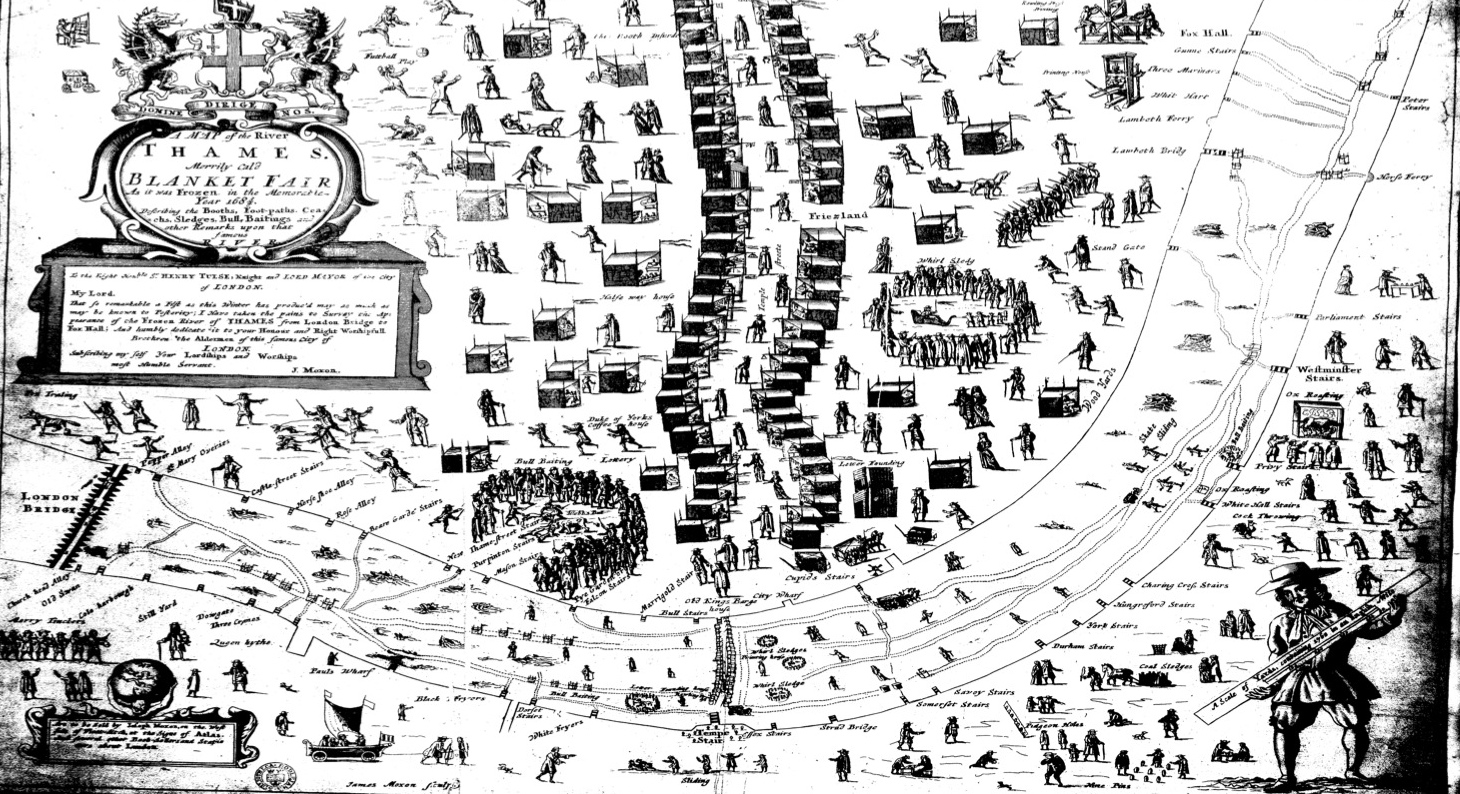
Blanket Fair


This woodcut depicts a Blanket Fair on the frozen Thames in 1684. The detail is really lovely. Download the image to explore.

The ballad which follows describes the Blanket Fair itself:
BLANKET-FAIR, OR THE History of Temple Street. Being a Relation of the merry Pranks plaid on the River Thames during the great Frost.
To the Tune of Packington's Pound. 
Come listen a while (though the Weather be cold)
In your Pockets & Plackets your Hands you may hold.
I'll tell you a Story as true as 'tis rare,
Of a River turn'd into a Bartholmew Fair.
Since old Christmas last
There has bin such a Frost,
That the Thimes has by half the whole Nation bin crost.
O Scullers I pity your fate of Extreams,
Each Land-nan is now become free of the Thames. 
'Tis some Lapand Acquaintance of Conjurer Oates,
That has ty'd up your Hands & imprison'd your Boats.
You know he was ever a friend to the Crew
Of all that to Admiral Iames has bin true.
Where Sculls once did Row
Men walk to and fro,
But e're four months are ended 'twill hardly be so.
Should your hopes of a thaw by this weather be crost,
Your Fortunes vould soon be as hard as the Frost. 
In Roast Beef and Brandy much money is spent
In Booths made of Blankets that pay no Ground-rent,
With old fashiond Chimneys the Rooms are secur'd,
And the Housed from danger of Fire ensur'd.
The chief place you meet
Is call'd Temple Street,
If you do not believe me, then you may go see't.
From the Tempe the Students do thither resort,
Tho were always great Patrons of Revels and sport. 
The Citizen comes with his Daughter or Wife,
And swears he never saw such a sight in his life:
the Prentices starv'd at home for want of Coals
catch them a heat do flock thither in shoals;
While the Country Squire
Does stand and admire
The wondrous conjunction of Water and Fire.
it comes an arch Wag, a young Son of a Whore,
lays the Squires head where his heels were before. 


The Rotterdam Dutchman with fleet cutting Scates,
To pleasure the crowd shews his tricks and his feats,
Who like a Rope-dancer (for all his sharp Steels)
His Brains and activity lie in his Heels.
Here all things like fate
Are in slippery state,
From the Sole of the Foot to the Crown of the Pate.
While the Rabble in Sledges run giddily round,
And nought but a circle of folly is found. 
Here Damsels are handed like Nymphs in the Bath,
By Gentlemen-Ushers with Legs like a Lath;
They slide to a Tune, and cry give me your Hand,
When the tottering Fops are scarce able to stand.
Then with fear and with care
They arrive at the Fair,
Where Wenches fell Glasses and crakt Earthen ware;
To shew that the World, and the pleasures it brings,
Are made up of brittle and slippery things. 
A Spark of the Bar with his Cane and his Muff,
One day went to treat his new rigg'd Kitchinstuff,
Let slip from her Gallant, the gay Damsel try'd
(As oft she had done in the Country) to slide,
In the way lay a stump,
That with a dam'd thump,
She broke both her Shoostrings and crippl'd her Rump.
The heat of her Buttocks made such a great thaw,
She had like to have drowned the man of the Law. 
All you that are warm both in Body and Purse,
I give you this warning for better or worse,
Be not there in the Moonshine, pray take my advice,
For slippery things have bin done on the Ice
Maids there have been said
To lose Maiden-head,
And Sparks from full Pockets gone empty to Bed·
If their Brains and their Bodies had not bin too warm,
'Tis forty to one they had come to less harm. 

You may also enjoy The air was more severely piercing than ever and Cold doings in London